
BOOK ANNOUNCEMENT!!
It’s a proud day when your daughter finds you on Target’s website.

“I looked u up online and look what came up” my teenage daughter texted 2day. “ur book is on targets official website for preorder”
“Cool!” I said.
“ikr” she wrote.
And just like that, dear reader, I am pleased to announce that The Last Man: A Biography of Xi Jinping will be coming to bookstores (and big box stores!) in early March, courtesy of St Martin’s Press. For just $31 it could be yours!
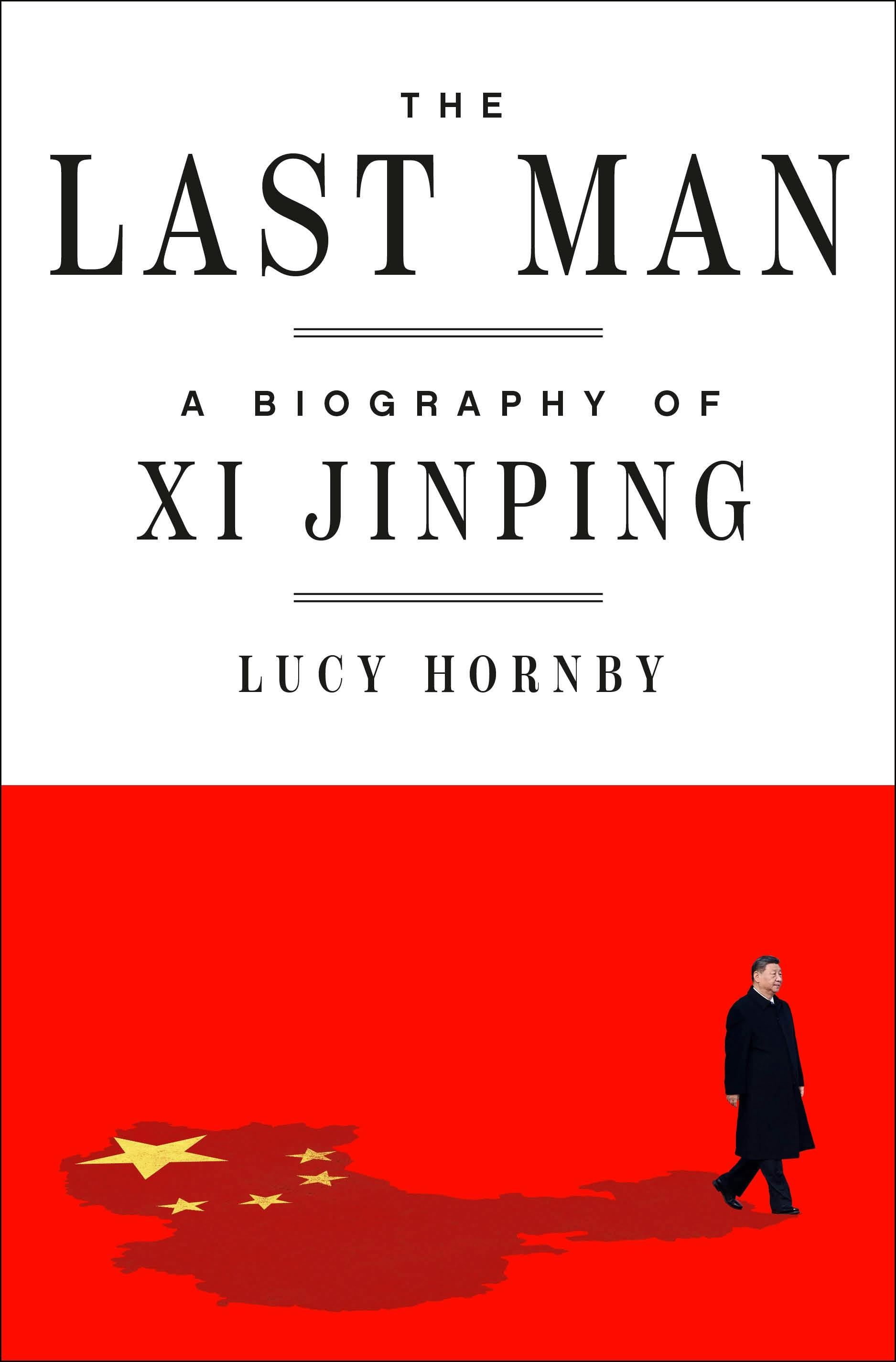
This biography has been a Biblical seven years in the making, researched and written after I moved back to the U.S. in the fall of 2019. I had lived in the People’s Republic of China for twenty years, fifteen of those as a reporter for Reuters (2004-2013) and the Financial Times (2013-2019). I experienced Xi Jinping’s first seven years in power as a reporter but also as a Beijing resident – paying taxes, navigating parenthood, preschools, smog and public transportation. I naively thought that would give me an entré into writing about Xi Jinping; I was wrong.
My job as a journalist had taken me to the physical locations that the Communist Party inhabits. I had reported from state guest houses in Shanghai and Beijing, from the central leadership compound at Zhongnanhai next to the Forbidden City, from the big ministries in Beijing, from Beidaihe, the elite seaside resort, and from the Central Party School, where doctrine is transmitted. Every March 5, I had climbed the red-carpeted steps into the magnificent Great Hall of the People to cover the National People’s Congress. I had visited most of the locales that were key to Xi Jinping’s story: his hometown, Beijing; the northwestern village where he went as a sent-down youth; the flat wheat fields of the North China Plain, the booming coastal towns of Fujian Province and the wealthy cities of Zhejiang. I was an outsider, of course, but I knew what Xi Jinping’s world looked and sounded like, and how it had changed during the transformative reform decades, because I had lived through those changes too.
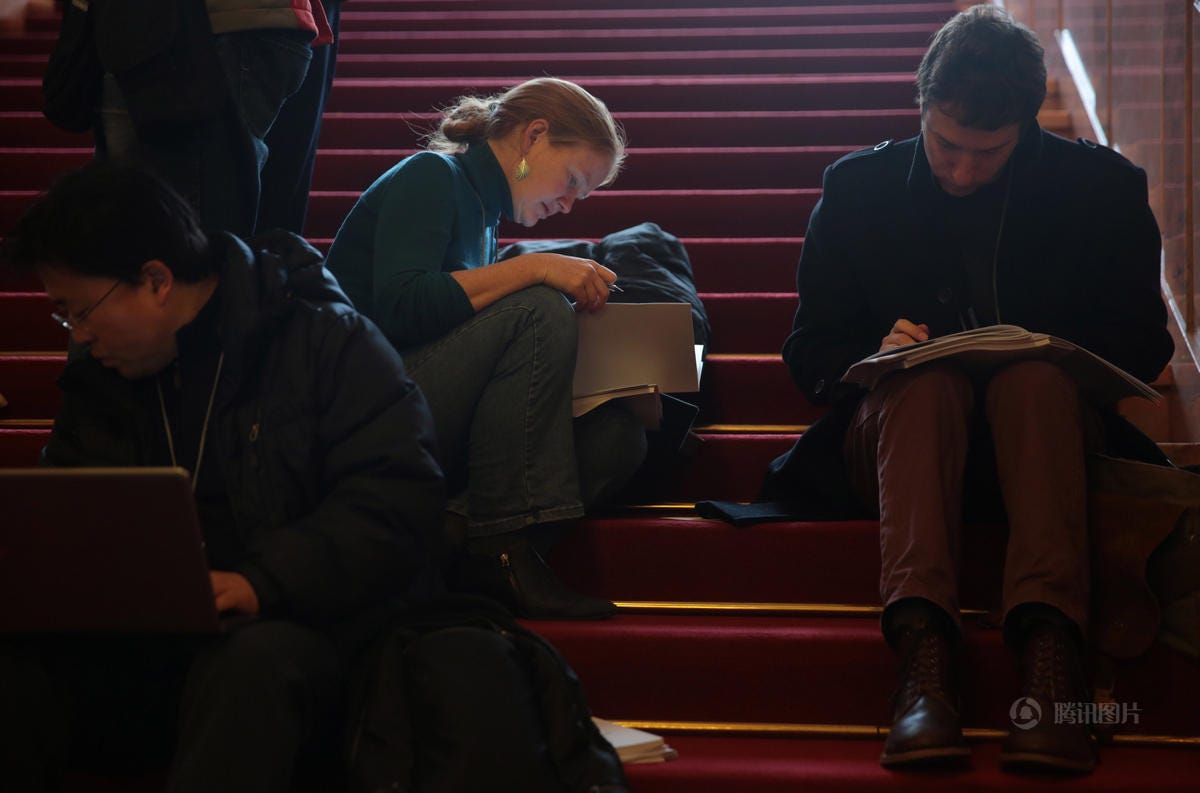
The unglamorous job of a news reporter, scanning the annual budget report on the steps of the Great Hall of the People
What I didn’t know, it turned out, was the world of the very tiny hereditary elite of the Communist Party. The Chinese Communist Party boasted about 4 million members when it “Liberated” (or “conquered” depending on your point of view) China in 1949; of those, perhaps 10,000 had any real influence. Power was heavily concentrated in the hands of several hundred men, mostly in their 40s and 50s, who controlled the Party and the army. “Today there are about 800 of us,” one senior Communist told American journalist Edgar Snow in 1960. “By and large the country is being run and for some years will be run by those 800.”[1] Xi Jinping’s father Xi Zhongxun was one of the youngest of those 800; his mother Qi Xin was one of the 10,000. The culture and society these revolutionaries bequeathed to their children was only rarely glimpsed by the Chinese citizens I interacted with.
Who would be my Virgil into this cloistered world? I started with the essays of Xi Jinping’s mother, Qi Xin, a fierce writer and ferocious Communist, and moved from there to the two-volume official biography of his father, Xi Zhongxun, which obfuscates as much as it reveals.[2] I plumbed the reminiscences of Xi Zhongxun’s secretaries, and delved into to the biographies and memoirs of a broader subset of those 10,000 revolutionaries, seeking out anyone had intersected with the Xi family trajectory. It was a painstaking process that left me with a great respect for those revolutionaries who stubbornly believed in recording their lives amid extraordinary times, and a growing awareness of what they had chosen not to tell. I felt grateful to all the scholars, both Chinese and foreign, who transmitted the untold parts of China’s difficult history to the outside world.
As Xi Jinping matured, the world of the revolutionaries fell away and the political rhythms of the reform era bureaucracy took over. This was the China that I had discovered when I first arrived in Wuhan in the 1990s, but once again, the ambitions and perspective of an elite princeling were very different from the ordinary people I knew. Thankfully, the Central Party School had conducted oral interviews of more than 200 officials who had worked with Xi Jinping, interviews that turned out to be surprisingly revealing once the thick layers of propaganda were stripped off. Chinese and foreign witnesses to the reform period abound; daily newspapers track officials’ comings and goings. The challenge was to distill the elements that specifically powered Xi Jinping’s career and outlook.
My goal from the beginning was to write a biography that was rigorous in research, but written for readers who are not necessarily China specialists. (I hope China specialists will find some nuggets in there too!) Much was left on the cutting room floor; hopefully what remains conveys the culture and mindset of the Chinese Communist Party which has surrounded Xi Jinping from birth.
In the course of writing, I became painfully, discouragingly aware of the most popular type of biography in America – the biographies of Abraham Lincoln and of the Founding Fathers, of which there is an infinite supply. Why are there so many of those, and so few of the Chinese leader who shapes our world today? Lincoln and the Founding Fathers and mothers are critical to who we are as a nation of course, but I concluded there’s another factor too – our familiarity with the cast of characters. We know that Washington’s false teeth bothered him and that Abe Lincoln was tall, that Martha Washington was merry and Mary Todd Lincoln depressed. Alexander Hamilton, Thomas Jefferson and Aaron Burr had an amazing ability to express themselves musically while working on the most important documents of our nation. We feel like we can read (or sing) our way into their world with ease.
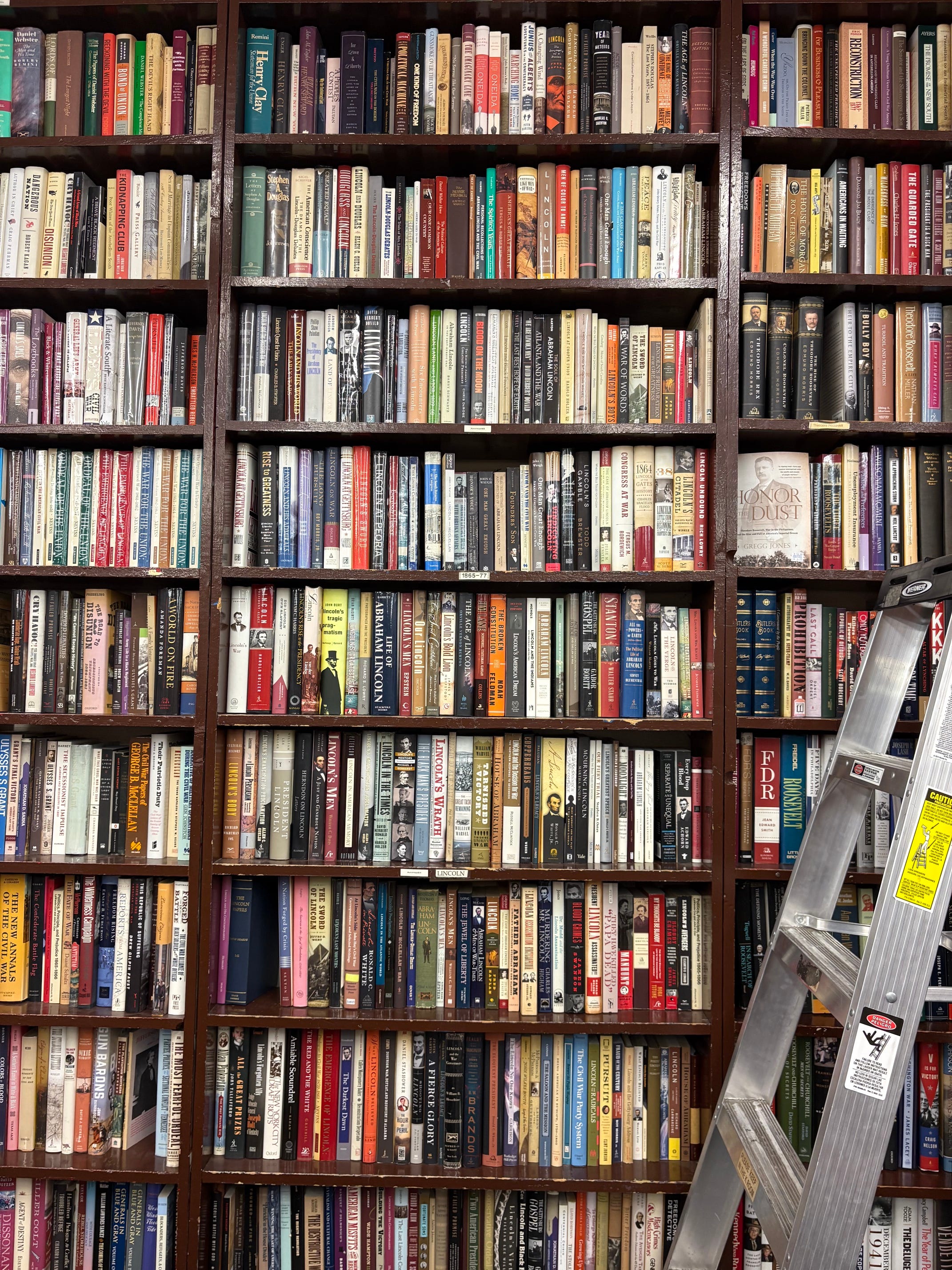
Nine whole shelves occupied by Abraham Lincoln, Powell’s Bookstore, Chicago.
Writing about China is different. For most Americans, the names of Chinese politicians are unfamiliar, the history is unfamiliar and the political system is unfamiliar. That’s a real barrier to entry for longer books on China, even though newspaper and feature-style reporting always attracts an engaged readership. I did not fully overcome this problem, but I sure tried.
Xi Jinping’s life has spanned nearly the entirety of the PRC’s existence; add in his parents’ lives, and you get the whole century of Communism in China. The part of the writing that I enjoyed most was mapping his personal experiences to this broader history.
I was motivated by both affection and dismay. Affection, because I was bit by the China bug before I emerged from the crowded arrivals hall of the Beijing airport on a rainy June day in 1995. I had come to China, speaking no Chinese, to teach English in Wuhan, a city of 7 million people which no-one outside of China had ever heard of (now you have, thanks to Covid). My students in Wuhan were my first window into the rapid reinvention of an entire country. I was fascinated by their constant questioning of “Who are we? Where are we going, as a nation and as a people?”
And dismay, well… after many years of witnessing the PRC move in the direction of greater prosperity and personal freedom, I was shocked and dismayed when Xi Jinping came into power and began reversing those trends. I wanted to understand why he was doing this. That set the book in motion. I researched Xi Jinping’s life journalistically – where was he at any given time? What was he doing? What were his experiences, and his frame of reference, when he undertook an action? Why did he do what he did? How does his trajectory so far inform what is to come?
Of course, because this is a biography of a living person, we don’t know how Xi Jinping’s story ends, or what historians will weigh in retrospect. Over the years, a wealth of documentation and gossip (小道消息, or “news picked up from the side of the road”) have filled in the blanks of Mao Zedong’s and Deng Xiaoping’s eras, all the way up to the traumatic crackdown on the Tiananmen protests of 1989. After that, the picture clouds, despite the best efforts of Sinologists, and by the time of Xi Jinping, it is completely opaque. We don’t know what Xi Jinping advocates in his Politburo Standing Committee meetings, when he “bangs the table” or when he yields to more knowledgeable lieutenants. Despite the relentless propaganda of Xi Jinping Thought, we don’t know what Xi Jinping actually thinks.
Another source of dismay, and my ultimate motivation for writing, is the state of our nation. As China’s influence grows, the U.S. and the rest of the world are gyrating between China-maxxing and China-threat narratives. The sudden appearance of a global rival after decades as Sole Superpower is forcing a painful mental reset. I humbly hope this book can be part of the public conversation of “Who are we? Where are we going, as a nation and as a people?”
And now, the pitch. I would be so honored if you could put in an order for The Last Man the next time you visit a bookstore in person. There are online options too – Macmillan has a nifty feature that allows you to order through a local bookstore (click Bookshop), or you can order through Macmillan itself. There’s Amazon, of course, and Target, too!
I can’t wait to hear your feedback.
Thank you!
[1] Edgar Snow, Red China Today: revised and updated edition of The Other Side of the River. New York: Vintage Books, 1970; p. 327.
[2] Alas, American scholar Joseph Torigian’s very thorough biography of Xi Zhongxun, The Party’s Interests Come First, was published after I had completed this stage of research.
I look forward to reading the book. I’ve known your Dad since our days at Princeton. China interests me greatly. Are you acquainted with John Pomfret?
Wow!! Congrats Lucy! Can’t wait to read it! When I was Ambassador, I spent five days in close quarters with Xi when he came to Oz on an official trip as Vice President in June 2010, the same week Kevin Rudd was deposed as Prime Minister!!